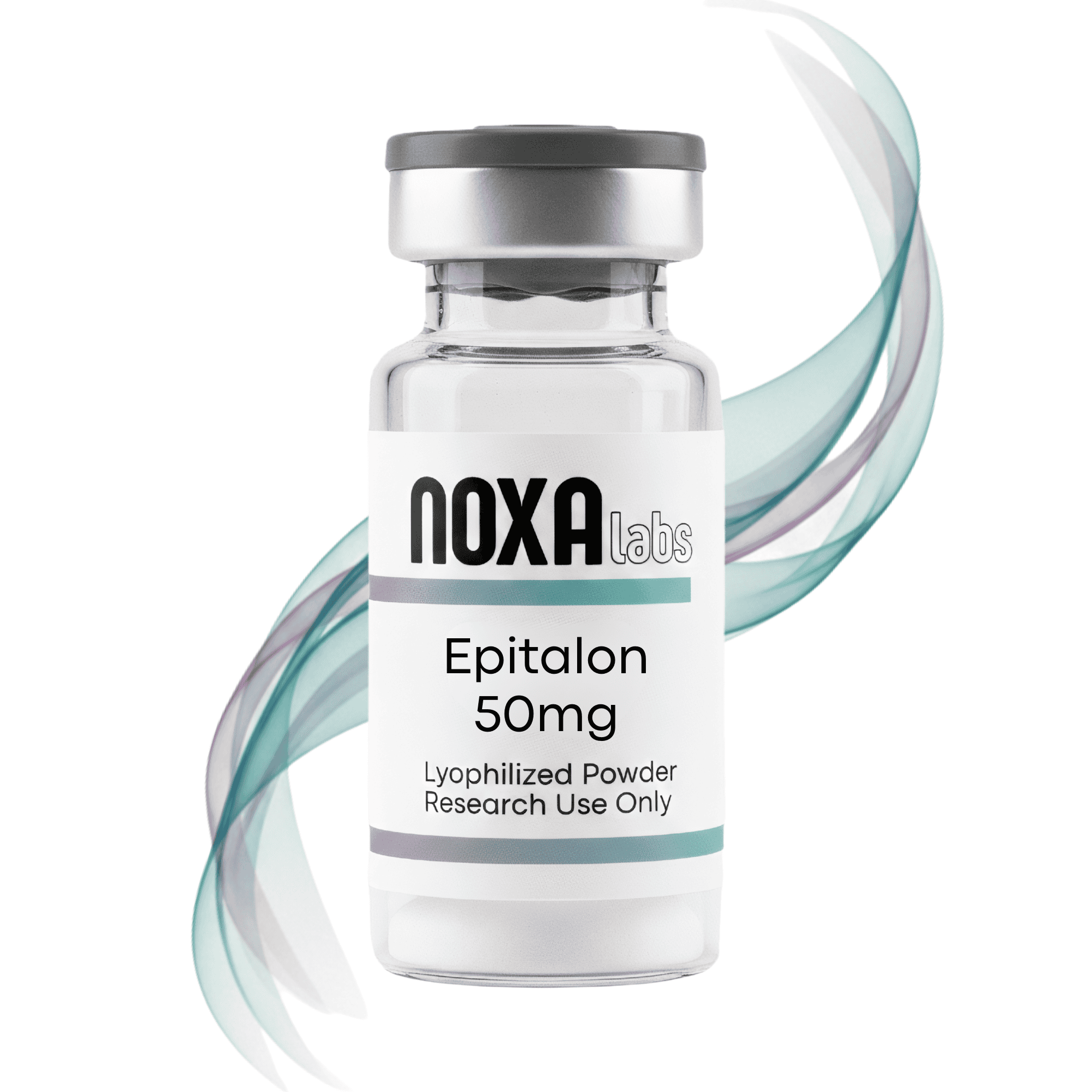
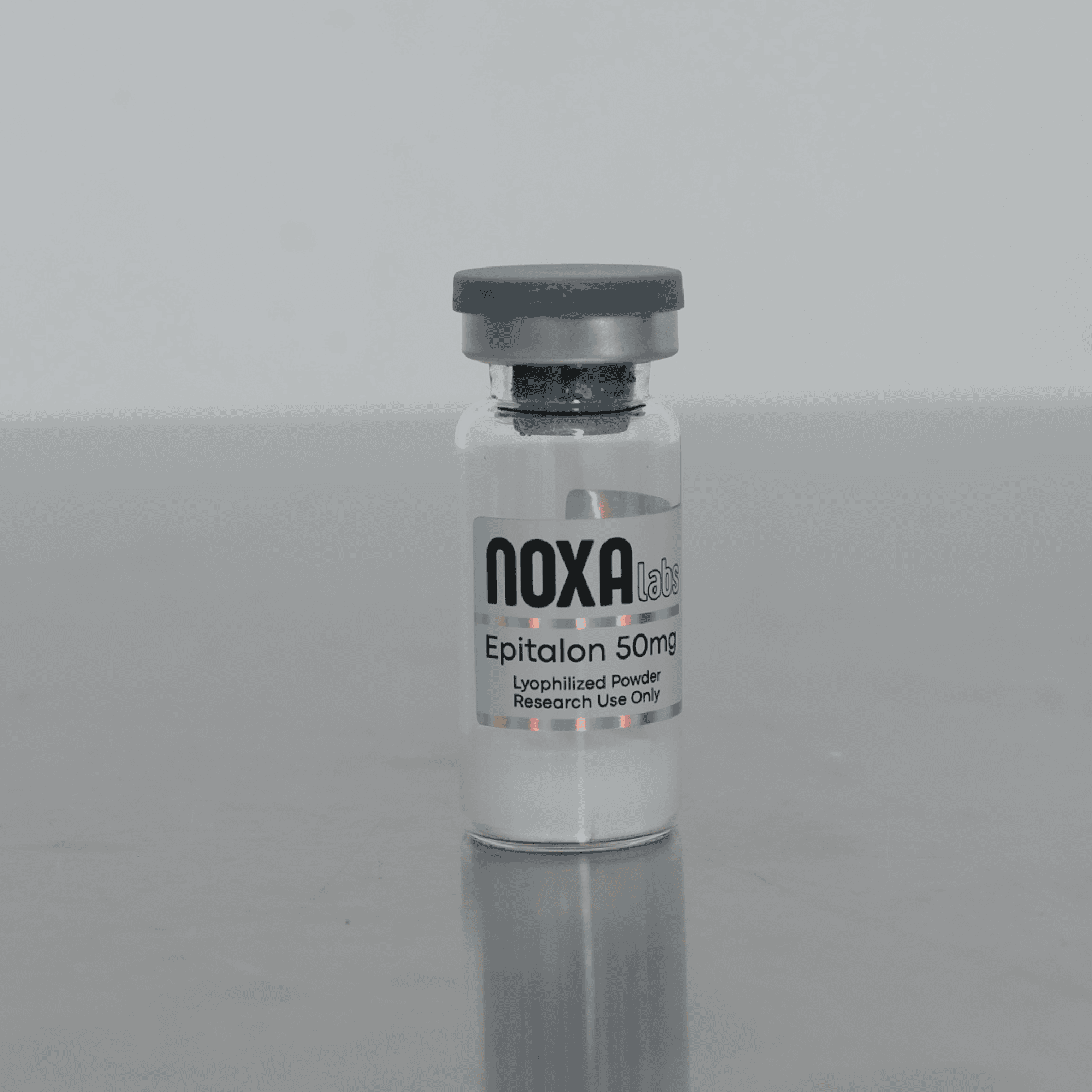
Epitalon
$100.00
Short research peptide studied in aging, cellular longevity, and telomere-related research.
In stock
Description
Compound Specifications
| Common name | Epitalon (Epithalon) |
| Sequence | Ala-Glu-Asp-Gly |
| Single-letter sequence | AEDG |
| Compound class | Synthetic tetrapeptide |
| Amino acid count | 4 |
| Molecular formula | C₁₄H₂₂N₄O₉ |
| Molecular weight | 390.35 g/mol |
| CAS number | 307297-39-8 |
| Form | Lyophilized powder |
| Quantity | 50mg per vial |
| Purity | ≥99% (HPLC verified) |
| Storage (lyophilized) | 2–8°C, protected from light |
| Storage (reconstituted) | 2–8°C, 30 days |
| Long-term storage | -20°C |
| Third-party testing | Freedom Diagnostics |
| Manufacturing | Arizona GMP facility, USA |
Verify sequence, molecular weight, formula and CAS number against batch COA prior to publication.
Research Background
Epitalon is a four-residue synthetic sequence: alanine, glutamic acid, aspartic acid, glycine. It emerged from a Russian research programme, associated principally with Khavinson and colleagues, concerned with short synthetic peptides — a body of work that produced a family of related sequences of which Epitalon is the most widely distributed.
Structurally, the sequence is notable for being strongly acidic relative to its length. Two of its four residues, glutamate and aspartate, carry negatively charged side chains at physiological pH. In a four-residue molecule that is a very high charge density, giving Epitalon a low isoelectric point and excellent aqueous solubility — it dissolves more readily than most compounds in this catalog. The corresponding trade-off is pronounced pH sensitivity: under acidic conditions those side chains protonate, charge density collapses, and solubility drops sharply.
The sequence contains no cysteine, no methionine, no tryptophan and no tyrosine. It therefore has no exposed thiol to oxidize and no aromatic residue to photodegrade, which makes it one of the more chemically robust materials we supply — a marked contrast with Glutathione or Kisspeptin-10. It also has no aromatic residues to absorb at 280nm, so UV spectrophotometry is not a usable method for determining concentration. HPLC or mass-based methods are required.
A substantial portion of the published literature concerning this compound and the related Khavinson peptides is in Russian. Researchers reviewing prior work should be aware that English-language sources represent only part of the available material.
All statements above describe molecular characteristics and published research contexts. Noxa Labs makes no claim regarding safety, efficacy, or outcomes of any kind, in humans or animals.
Handling & Storage
Lyophilized Epitalon is stable at 2–8°C when sealed and shielded from light. For storage beyond several months, -20°C is preferred. Avoid repeated freeze-thaw cycles.
Introduce bacteriostatic water slowly down the inner wall of the vial rather than directly onto the powder. Swirl gently; dissolution is rapid given the sequence’s high charge density. The solution should be clear, colourless and particulate-free.
Avoid acidic conditions. Solubility falls sharply as the glutamate and aspartate side chains protonate. Neutral aqueous conditions are appropriate; if precipitation occurs, low pH is the likely cause.
Once in solution, store at 2–8°C and use within 30 days. A 50mg vial reconstituted with 5mL of bacteriostatic water yields a 10mg/mL concentration.
Concentration and volume calculator →
Purity & Testing
Every batch is synthesized at our GMP-compliant Arizona facility and independently analyzed by Freedom Diagnostics before release. We publish HPLC purity data and endotoxin testing results — we don’t ask you to take our word for it. Certificates of Analysis are available for any lot; contact us with your order number.
View all Certificates of Analysis →
Frequently Asked Questions
What is the sequence of Epitalon?
Ala-Glu-Asp-Gly, a four-residue synthetic tetrapeptide.
Why does Epitalon dissolve so readily?
Two of its four residues carry negatively charged side chains at neutral pH, giving very high charge density for a molecule this small.
Why should acidic conditions be avoided?
Under acidic conditions the glutamate and aspartate side chains protonate, charge density falls, and solubility drops sharply.
Can concentration be determined by UV absorbance?
No. The sequence contains no aromatic residues and does not absorb usefully at 280nm. Use HPLC or mass-based methods.
Where does the research on this compound originate?
From Russian peptide research programmes, associated principally with Khavinson and colleagues. Much of the literature is published in Russian.
What size is available?
50mg lyophilized vials.
Related Research Compounds
- Semax 10mg — also from Russian peptide research
- KPV 10mg — short sequence, comparably robust handling
- Certificates of Analysis — batch testing data
Research Use Only
For Research Use Only. This product is intended solely for laboratory research purposes. It is not a drug, food, dietary supplement, or cosmetic and may not be misbranded, misused, or mislabeled as such. Not for human or veterinary use. Not for diagnostic or therapeutic use. Not for resale without authorization.
Related products
-
 ✓ Verified
GHK-Cu
99% PUREUSA MADE3RD PARTY TESTEDFrom $80.00 Select options This product has multiple variants. The options may be chosen on the product page -
✓ Verified
GLOW Stack
99% PUREUSA MADE3RD PARTY TESTED$170.00 Add to cart -
✓ Verified
SS-31
99% PUREUSA MADE3RD PARTY TESTED$160.00 Add to cart -
✓ Verified
NAD+
99% PUREUSA MADE3RD PARTY TESTED$180.00 Add to cart