SS-31
FOR NON-CLINICAL LABORATORY RESEARCH USE ONLY
This product is sold exclusively to approved business and institutional purchasers for lawful laboratory research or analytical use. It is not intended for human or animal consumption, ingestion, inhalation, injection, topical application, or other administration.
Read full use restrictions
This product must not be used for medical, therapeutic, diagnostic, prophylactic, clinical, veterinary, compounding, food, animal-feed, dietary-supplement, cosmetic, household, recreational, or personal purposes. It may not be resold or otherwise distributed to individual consumers.
Purchasers must review the product label, Certificate of Analysis, and applicable Safety Data Sheet and maintain appropriately trained personnel, facilities, storage, handling, transportation, and disposal procedures.
$150.00
In stock
Description
Compound Specifications
| Common name | SS-31 (elamipretide) |
| Sequence | D-Arg-Dmt-Lys-Phe-NH₂ |
| Amino acid count | 4 |
| Non-standard residues | D-Arg, Dmt (2,6-dimethyltyrosine) |
| C-terminus | Amidated |
| Structural motif | Alternating cationic / aromatic |
| Molecular weight | 639.8 g/mol |
| CAS number | 736992-21-5 |
| Form | Lyophilized powder |
| Quantity | 50mg per vial |
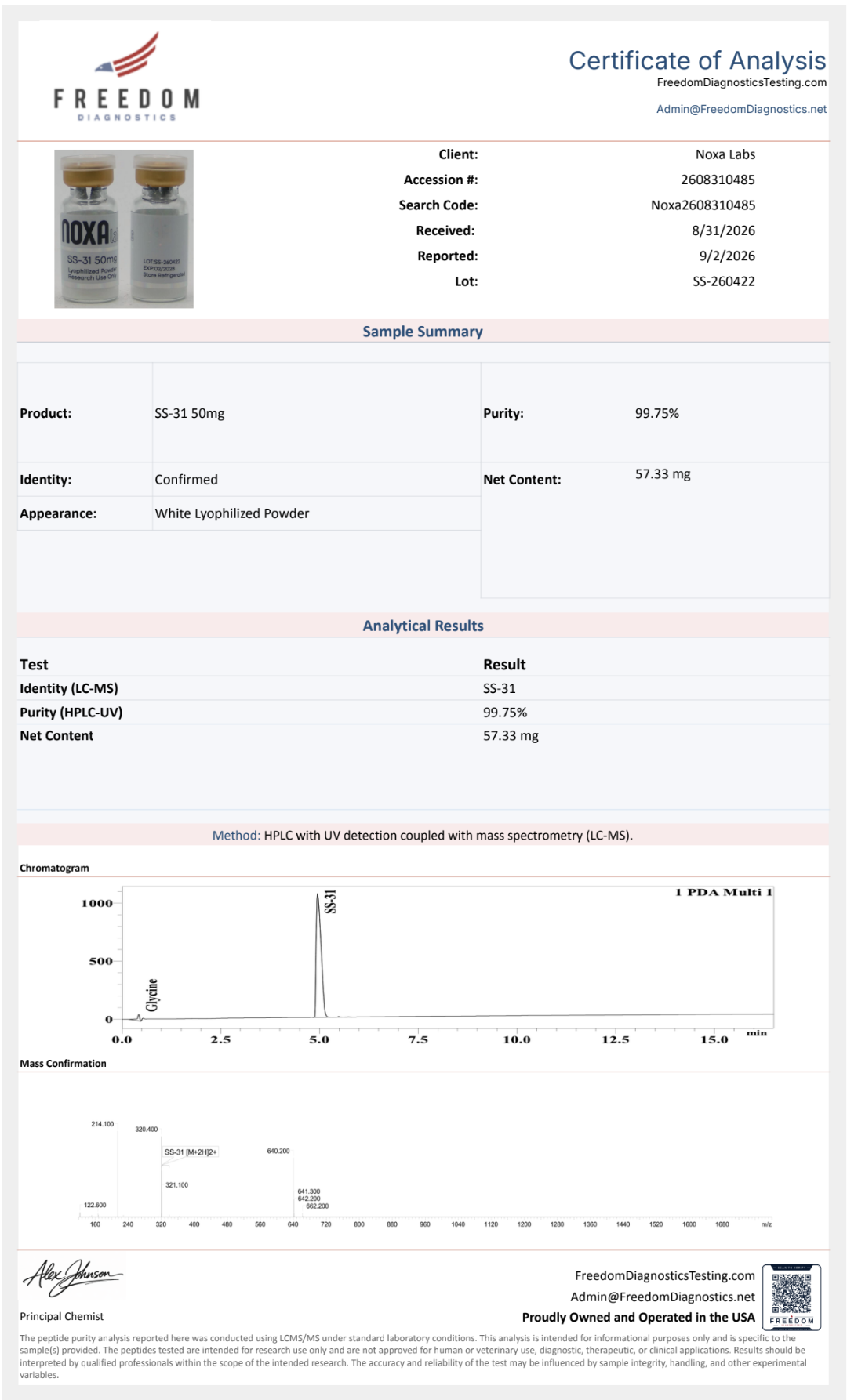
| Purity | ≥99% (HPLC verified) |
| Storage (lyophilized) | 2–8°C, protected from light |
| Third-party testing | Freedom Diagnostics |
Research Background
SS-31 is a four-residue peptide whose defining property comes not from any single residue but from the alternating pattern in which they are arranged: cationic, aromatic, cationic, aromatic. D-arginine, 2,6-dimethyltyrosine, lysine, phenylalanine.
That alternation produces a molecule with distinct charged and hydrophobic faces. Cardiolipin — a phospholipid found almost exclusively in the inner mitochondrial membrane — presents a strongly anionic surface, and the compound’s cationic residues associate with it while the aromatic residues interact with the surrounding lipid environment. This is the basis of the compound’s characterization in the literature as mitochondria-targeting: the selectivity arises from a lipid-binding interaction rather than from receptor recognition, which distinguishes it from essentially every other compound in this catalog.
Two of the four residues are non-standard. D-arginine is the mirror-image stereoisomer of the natural L-form. 2,6-dimethyltyrosine carries two methyl groups on the aromatic ring, which alters both the electronic character of the ring and the conformational freedom of the side chain. Together with C-terminal amidation, these modifications leave the molecule largely unrecognizable to proteases.
At four residues with a net positive charge and a defined amphipathic character, SS-31 belongs to a small class of peptides designed around membrane interaction rather than around a binding pocket. MOTS-C, the other mitochondrially associated compound in this catalog, works from an entirely different premise — it is a mitochondrially encoded signaling peptide, not a synthetic membrane-targeting construct.
All statements above describe molecular characteristics and published research contexts. Noxa Labs makes no claim regarding safety, efficacy, or outcomes of any kind, in humans or animals.
Handling & Storage
Lyophilized SS-31 is stable at 2–8°C when sealed and shielded from light. For storage beyond several months, -20°C is preferred. The dimethyltyrosine residue is aromatic and moderately photosensitive; protect from prolonged light exposure, though the compound is less light-labile than tryptophan-containing sequences such as Kisspeptin-10 or PT-141.
Purity & Testing
Every batch is synthesized at our GMP-compliant Arizona facility and independently analyzed by Freedom Diagnostics before release. Certificates of Analysis are available for any lot; contact us with your order number.
View all Certificates of Analysis →
Frequently Asked Questions
What is the alternating cationic-aromatic motif?
The four residues alternate between positively charged and aromatic, producing a molecule with distinct charged and hydrophobic faces.
What is cardiolipin?
A phospholipid found almost exclusively in the inner mitochondrial membrane. It presents a strongly anionic surface.
What is Dmt?
2,6-dimethyltyrosine — tyrosine with two methyl groups on the aromatic ring, altering ring electronics and side-chain conformational freedom.
How does SS-31 differ from MOTS-C?
Both are associated with mitochondria but on entirely different premises. SS-31 is a synthetic membrane-targeting construct; MOTS-C is a mitochondrially encoded signaling peptide.
Why does labware matter for this compound?
Cationic peptides adsorb to glass and some plastics, which can affect measured concentration.
Related Research Compounds
- MOTS-C — mitochondrially encoded peptide, different premise
- NAD+ 500mg — coenzyme in mitochondrial metabolism
Research Use Only
For Research Use Only. This product is intended solely for laboratory research purposes. It is not a drug, food, or cosmetic and may not be misbranded, misused, or mislabeled as such. Not for human or veterinary use. Not for diagnostic or therapeutic use. Not for resale without authorization.
Related products
-

5-Amino-1MQ
$120.00 Add to cart -
Glutathione
$90.00 Add to cart -
MOTS-C
From $70.00 Select options This product has multiple variants. The options may be chosen on the product page -
GLOW Stack
$140.00 Add to cart