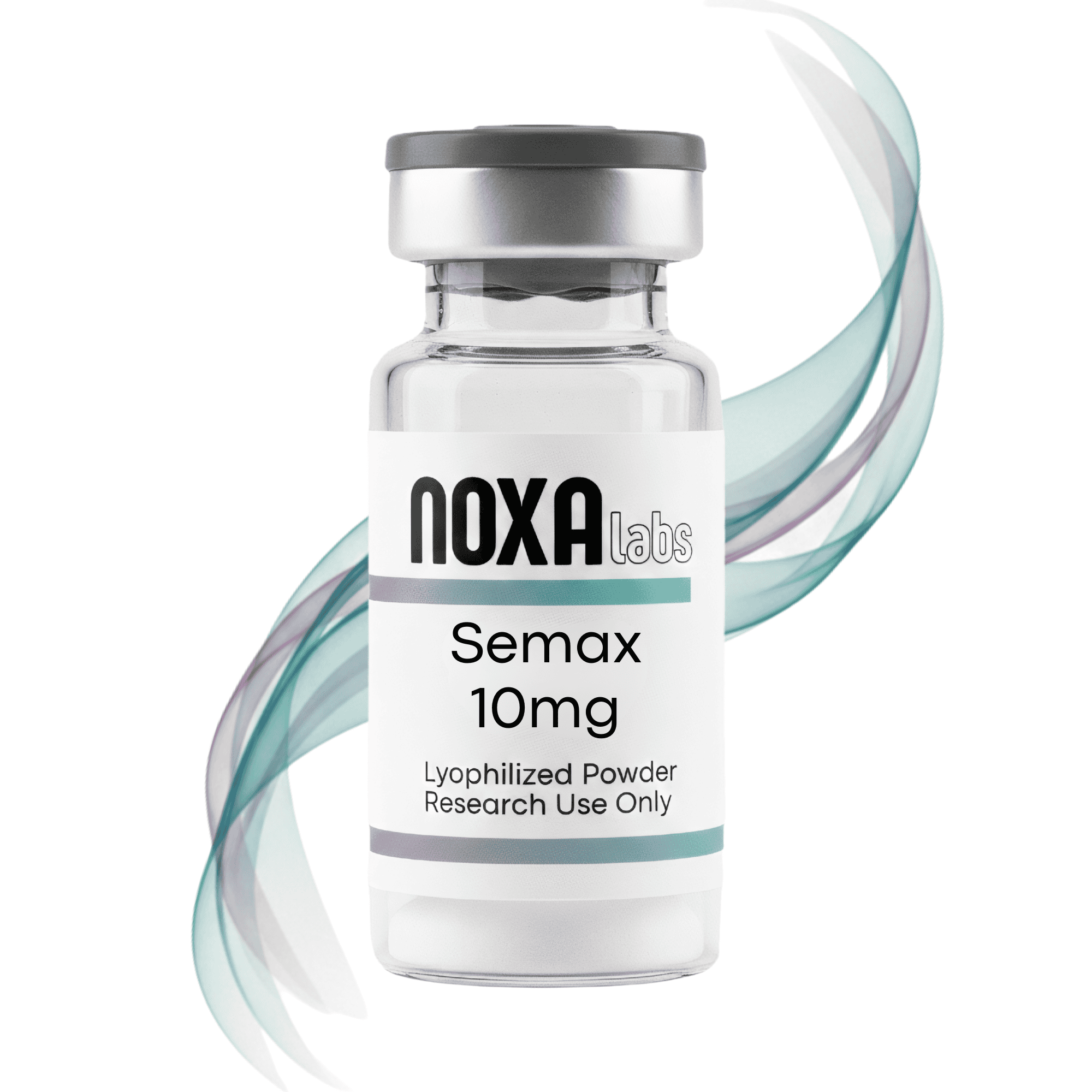


Semax
FOR NON-CLINICAL LABORATORY RESEARCH USE ONLY
This product is sold exclusively to approved business and institutional purchasers for lawful laboratory research or analytical use. It is not intended for human or animal consumption, ingestion, inhalation, injection, topical application, or other administration.
Read full use restrictions
This product must not be used for medical, therapeutic, diagnostic, prophylactic, clinical, veterinary, compounding, food, animal-feed, dietary-supplement, cosmetic, household, recreational, or personal purposes. It may not be resold or otherwise distributed to individual consumers.
Purchasers must review the product label, Certificate of Analysis, and applicable Safety Data Sheet and maintain appropriately trained personnel, facilities, storage, handling, transportation, and disposal procedures.
$90.00
In stock
Description
Compound Specifications
| Compound class | Synthetic ACTH fragment analog |
| Sequence | Met-Glu-His-Phe-Pro-Gly-Pro |
| Single-letter sequence | MEHFPGP |
| Amino acid count | 7 |
| Parent fragment | ACTH(4–7), Met-Glu-His-Phe |
| C-terminal extension | Pro-Gly-Pro |
| Molecular weight | 813.9 g/mol |
| CAS number | 80714-61-0 |
| Form | Lyophilized powder |
| Quantity | 10mg per vial |
| Purity | ≥99% (HPLC verified) |
| Endotoxin testing | Performed per batch |
| Storage (lyophilized) | 2–8°C, protected from light |
| Long-term storage | -20°C |
| Third-party testing | Freedom Diagnostics |
| Manufacturing | Arizona GMP facility, USA |
Research Background
Semax is a seven-residue synthetic peptide constructed from two distinct parts. The first four residues — Met-Glu-His-Phe — correspond to positions 4 through 7 of adrenocorticotropic hormone, a 39-amino-acid pituitary hormone. The remaining three residues, Pro-Gly-Pro, are not part of the ACTH sequence at all.
That appended tripeptide is the compound’s defining feature. Proline-containing sequences are markedly resistant to exopeptidase activity, because the cyclic side chain of proline constrains the backbone geometry that peptidases require in order to engage a terminus. Flanking a glycine with two prolines produces a C-terminal cap that is difficult to trim enzymatically. The result is a short peptide with far greater stability than a bare four-residue ACTH fragment would possess.
This design approach — taking a biologically characterized fragment and appending a proline-rich stabilizing tail — distinguishes Semax from every other compound in the Noxa Labs catalog. TB-500 is a fragment presented unmodified. Tesamorelin is a full sequence with a chemical group attached at one end. Ipamorelin is built from non-natural residues throughout. Semax is a hybrid: a natural fragment fused to a synthetic stabilizing extension.
The compound originates from Russian pharmacological research conducted from the 1980s onward, and a substantial portion of the literature concerning it is published in Russian. Researchers reviewing published work on this compound should be aware that the English-language literature represents only part of the available material.
All statements above describe molecular characteristics and published research contexts. Noxa Labs makes no claim regarding safety, efficacy, or outcomes of any kind, in humans or animals.
Handling & Storage
Lyophilized Semax is stable at 2–8°C when sealed and shielded from light. For storage beyond several months, -20°C is preferred. Avoid repeated freeze-thaw cycles. The N-terminal methionine is susceptible to oxidation. Keep vials sealed when not in use, and avoid prolonged bench time at room temperature.
Purity & Testing
Every batch is synthesized at our GMP-compliant Arizona facility and independently analyzed by Freedom Diagnostics before release. We publish HPLC purity data and endotoxin testing results — we don’t ask you to take our word for it. Certificates of Analysis are available for any lot; contact us with your order number.
View all Certificates of Analysis →
Frequently Asked Questions
What is Semax derived from?
The first four residues correspond to positions 4–7 of adrenocorticotropic hormone. The final three residues, Pro-Gly-Pro, are a synthetic addition not found in the ACTH sequence.
What does the Pro-Gly-Pro extension do?
It acts as a stabilizing cap. Proline’s cyclic side chain constrains backbone geometry in a way that resists exopeptidase activity, protecting the peptide from C-terminal degradation.
Is Semax a natural peptide?
Partly. Four of its seven residues correspond to a natural hormone fragment; the remaining three are a synthetic extension. The complete molecule does not occur naturally.
Where does the research on this compound come from?
It originates largely from Russian pharmacological research beginning in the 1980s, and much of the published literature is in Russian.
What size is available?
10mg lyophilized vials.
Related Research Compounds
- MOTS-C — 16-residue signaling peptide, separate research class
- Certificates of Analysis — batch testing data
Research Use Only
For Research Use Only. This product is intended solely for laboratory research purposes. It is not a drug, food, or cosmetic and may not be misbranded, misused, or mislabeled as such. Not for human or veterinary use. Not for diagnostic or therapeutic use. Not for resale without authorization.
Related products
-

SS-31
$150.00 Add to cart -
5-Amino-1MQ
$120.00 Add to cart -
KLOW Stack
$150.00 Add to cart -
MOTS-C
From $70.00 Select options This product has multiple variants. The options may be chosen on the product page