

Tesamorelin
From $100.00
GHRH analog studied for stimulating natural growth hormone release and supporting metabolic research.
Description
Compound Specifications
| Compound class | Synthetic GHRH analog |
| Parent sequence | Human growth hormone-releasing factor, hGRF(1–44) |
| Amino acid count | 44 |
| N-terminal modification | trans-3-hexenoyl group |
| Receptor target (in vitro) | GHRH receptor |
| Molecular weight | 5135.9 g/mol |
| CAS number | 218949-48-5 |
| Form | Lyophilized powder |
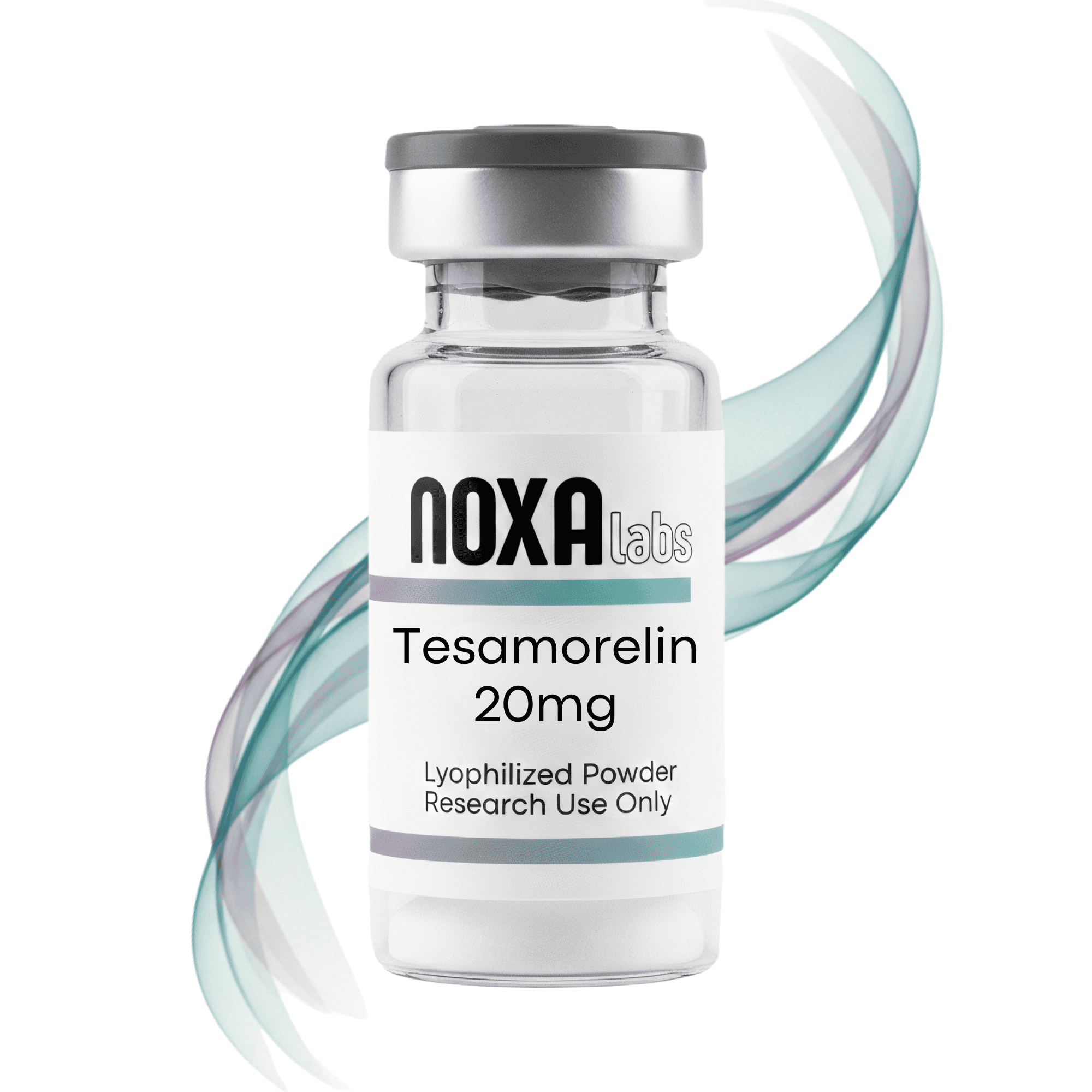
| Available quantities | 10mg, 20mg per vial |
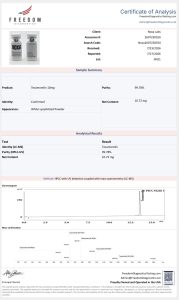
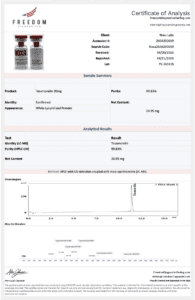
| Purity | ≥99% (HPLC verified) |
| Endotoxin testing | Performed per batch |
| Storage (lyophilized) | 2–8°C, protected from light |
| Storage (reconstituted) | 2–8°C, 30 days |
| Long-term storage | -20°C |
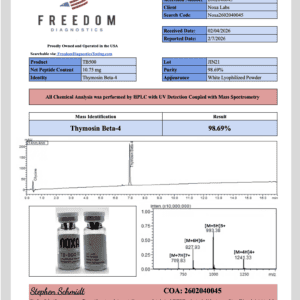
| Third-party testing | Freedom Diagnostics |
| Manufacturing | Arizona GMP facility, USA |
Verify molecular weight and CAS number against batch COA prior to publication.
You will receive 2 10mg bottles if the 20mg are sold out.
Research Background
Tesamorelin is a synthetic analog of growth hormone-releasing hormone, the 44-amino-acid hypothalamic peptide also designated hGRF(1–44). It is among the longest sequences in the Noxa Labs catalog — roughly three times the length of BPC-157 and more than six times that of TB-500 — which has direct consequences for how it is synthesized, purified and handled.
The defining structural feature is a trans-3-hexenoyl group attached at the N-terminus. Native GHRH is rapidly degraded by dipeptidyl peptidase-4, which cleaves at the N-terminal end; the hexenoyl modification obstructs that cleavage site. This is a stabilization strategy rather than a change in receptor interaction — the modified peptide engages the same GHRH receptor as the unmodified sequence, but persists substantially longer in the systems where it is studied.
At 44 residues, Tesamorelin sits at the boundary between what is conventionally described as a peptide and what is described as a small protein. Solid-phase synthesis at this length is materially more demanding than for short sequences, and the probability of deletion sequences and truncation products rises with each coupling step. This is why HPLC verification carries more weight for a compound of this size than it does for a seven-residue fragment.
A pharmaceutical formulation of tesamorelin holds FDA approval for a specific indication. The material supplied here is not that product, is not manufactured to pharmaceutical specification, and is supplied solely for laboratory research. Noxa Labs makes no claim regarding safety, efficacy, or outcomes of any kind, in humans or animals.
Handling & Storage
Lyophilized Tesamorelin is stable at 2–8°C when sealed and shielded from light. For storage beyond several months, -20°C is preferred. Avoid repeated freeze-thaw cycles.
Long sequences are more susceptible to aggregation than short ones. Introduce bacteriostatic water slowly down the inner wall of the vial rather than directly onto the powder, and allow the vial to stand briefly rather than agitating it toward dissolution. Swirl gently. Do not shake or vortex — mechanical agitation promotes aggregation in peptides of this length far more readily than in shorter sequences.
Dissolution may be slower than with the short peptides in this catalog. The finished solution should be clear and free of particulates. Haze, visible strands or precipitate indicate aggregation — discard the vial.
Once in solution, store at 2–8°C and use within 30 days.
Concentration and volume calculator →
Purity & Testing
Every batch is synthesized at our GMP-compliant Arizona facility and independently analyzed by Freedom Diagnostics before release. We publish HPLC purity data and endotoxin testing results — we don’t ask you to take our word for it. Certificates of Analysis are available for any lot; contact us with your order number.
View all Certificates of Analysis →
Frequently Asked Questions
What is the trans-3-hexenoyl group for?
It obstructs the N-terminal site where dipeptidyl peptidase-4 cleaves native GHRH. The modification is a stability strategy; it does not alter which receptor the peptide engages.
How does Tesamorelin differ from CJC-1295?
Both are GHRH-derived. Tesamorelin is a 44-residue analog of the full sequence. CJC-1295 is a 29-residue modified fragment. Different lengths, different modification strategies.
Why does purity verification matter more for this compound?
Synthesis error accumulates with sequence length. At 44 residues the likelihood of deletion and truncation by-products is considerably higher than for a short peptide, making HPLC characterization more consequential.
Why is it slower to dissolve?
Longer sequences dissolve more slowly and aggregate more readily. Allow time rather than agitating.
Is this the same as the approved pharmaceutical product?
No. This material is supplied for laboratory research only and is not manufactured to pharmaceutical specification.
What sizes are available?
10mg and 20mg lyophilized vials.
Related Research Compounds
- CJC-1295 + Ipamorelin Blend 10mg — separate GHRH-derived research class
- Certificates of Analysis — batch testing data
Research Use Only
For Research Use Only. This product is intended solely for laboratory research purposes. It is not a drug, food, or cosmetic and may not be misbranded, misused, or mislabeled as such. A pharmaceutical formulation of this compound is approved for a specific medical indication; this material is not that product and is not supplied for any therapeutic purpose. Not for human or veterinary use. Not for diagnostic or therapeutic use. Not for resale without authorization.
Additional information
| Strength | 10mg, 20mg |
|---|